
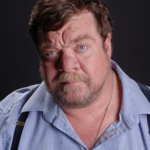

Adam Fortunate Eagle, a human whirlwind who spun amazing stories, was a newspaperman’s dream.
Fortunate Eagle “scalped” Columbus in San Francisco in 1968. Later, he landed in Europe, in Chippawa Indian regalia, to “discover”—and claim—both Italy and Sweden for Native Americans. He once offered his ring to the Pope to kiss. He was the architect of the American Indian takeover of Alcatraz Island in 1969. The FBI then labeled him an “enemy of the state”—a designation that pleased him.
At his home on the Fallon Paiute-Shoshone Reservation, he sculpted intricate ceremonial pipes and carved monumental statuary. He wrote books about the Alcatraz protest, articles about many other Native American issues, and penned a memoir about his childhood in a Minnesota Indian boarding school.
Reporter’s stories about him “wrote themselves,” as journalists say. Fortunate Eagle, 96, died in Fallon on May 11 after a short illness.
“He was larger than life,” said his daughter, nila northSun, an award-winning poet. “He kept reinventing himself. He packed so many lives into one lifetime—artist, activist, writer. He even did some acting.”
He loved to laugh and enjoyed mischief. The late Vine Deloria Jr., author of Custer Died for Your Sins: An Indian Manifesto, wrote in 1992: “Fortunate Eagle is the trickster incarnate, skipping through swamps and glades where mere mortals feared to tread. It’s hard to think of him as an elder because in my latest encounter with him, we looted one of his relatives’ fish smoke houses at Red Lake, Minnesota, and had to flee the county before the Tribal Police incarcerated us.”
Fortunate Eagle, whose birth name is Adam Nordwall, was born on the Red Lake Indian Reservation in 1929. He attended the Pipestone Indian School in Minnesota. In the 1960s, he was living in San Francisco with his wife, Bobbie, a member of the Shoshone Tribe, and their three children. He owned a termite extermination business. Fortunate Eagle became involved with the American Indian community there, eventually becoming chairman of the United Bay Area Council of American Indian Affairs. He soon became an activist.

Each Columbus Day, San Francisco’s Italian community held an event featuring residents in costume as Columbus and his crew. The Navigator and his entourage would land on the beach at Aquatic Park. The participants would be greeted by friendly Indians who would shower Columbus with gifts after he planted the Spanish flag in the sand and “discovered” America.
In 1968, Fortunate Eagle played the role of the Indian chief at the ceremony. Columbus approached the “chief” for his annual hug. “Not this year,” Fortunate Eagle wrote in an article in the St. Thomas Law Review in 1997. “Instead, I took my coup stick and pushed him down to the sand. When we grabbed his page-boy wig and pulled it off, the old boy was bald headed.”
Some audience members cried, “My God, the Indians have scalped Columbus!” Fortunate Eagle wrote. The faux Columbus grinned, but the following year, a cadre of police were on hand to protect the Admiral of the Ocean Sea from another uprising.
Occupying Alcatraz
Soon after, Fortunate Eagle helped plan an Indian occupation of Alcatraz Island, which had been abandoned by the Federal Bureau of Prisons. In November 1969, a group of Indians led by Richard Oakes and Ed Castillo landed on the island and read a proclamation written by Fortunate Eagle, who was out of town during the protest. Upon his return, Fortunate Eagle coordinated the logistics of the 19-month protest from the shore and was the point man for the media. He wrote about the experience in two books: Alcatraz! Alcatraz! The Indian Occupation of 1969-1971 in 1992, and in Heart of the Rock: The Indian Invasion of Alcatraz in 2008, which describes the protest’s effect on U.S. Indian policy.

“We woke up the media, the government and the people,” Fortunate Eagle told a Reno reporter in 2004. “Indians were not a vanished race. We were alive and active. We were warriors without weapons.”
Fortunate Eagle later taught Native American studies at California State University, Hayward. In September 1973, on his way to a European conference, he exited the plane in Rome in Chippawa regalia and claimed the country for the American Indians. The story ran around the world, prompting Pope Paul VI to invite him to the Vatican. The Pontiff offered Fortunate Eagle his ring to kiss; Adam responded by extending his own ring to the prelate, who smiled and clasped his hand.
In keeping with the new American Indian ownership of Italy, the activist announced the creation of a “Bureau of Italian Affairs” and appointed Italian actress Gina Lollobrigida as the “titular head” of the agency.
There are scores of other stories about Fortunate Eagle; they all show that when he got passionate about an injustice, he didn’t get angry—he got satirical. In 2009, a Reno reporter asked him about some other activists who complained he wasn’t serious enough about Indian issues. “They can kiss my ass,” he replied. “I don’t give a damn about my critics. They don’t live my life. I don’t make any apologies.”
Fortunate Eagle and his family moved to the Fallon Paiute-Shoshone Reservation in 1975. He and Bobbie built the Roundhouse Gallery on the property, a structure made of used tires packed with sand. The gallery, with Aztec, Maya and Toltec designs carved around its entrance, is a showcase for Indigenous art, including Fortunate Eagle’s pieces. He carved ceremonial pipes, now prized by collectors, and sculpted large and small statuary.
“He really began to learn how to sculpt in Italy, when he went to the marble mines, the quarries,” northSun said. “Eventually, he carved in wood, because that’s a lot easier than the stone.”
A reporter who interviewed Fortunate Eagle many times over the decades always had the same experience at Fortunate Eagle’s home: Adam would be in his office, surrounded by artwork in progress, as well as stacks of file folders and legal pads, news clippings, photos and faxes. Each time, he had a batch of ideas for new projects and artwork, breathlessly describing them to his visitor and hopping from one topic to another at lightning speed. Sometimes he’d go off on tangents about history or politics, geology or astronomy.
A low-tech Renaissance man

His mind seemed to work at the speed of a computer, which is lucky, because he never owned one. Instead, family members printed out whatever research he needed from their own machines. Over the years, his daughter and others unsuccessfully tried to get him interested in the internet.
“I tried to tell him,” northSun said. “But he didn’t use the washing machine or operate the microwave (either). He was an artist and a storyteller and wasn’t interested in anything that required pushing buttons.”
Fortunate Eagle piled up accolades, awards and honors during the last half-century, including a Nevada Governor’s Arts Award in 1996 and an honorary Doctorate of Humane Letters from the State University of New York, New Paltz, in 2001.
His daily grind of research and artistry continued well into his 80s, when he started to slow down, but he continued to write every day, filling legal pads with project ideas and stories. His other books include Pipestone: My Life in an Indian Boarding School and Scalping Columbus and Other Damn Indian Stories: Truths, Half-Truths, and Outright Lies.
Fortunate Eagle fell at his home about two weeks before he died and went to the hospital. He apparently suffered a brain injury, but the stories kept coming as he rested in his room.
“He talked for 24 hours and did not sleep,” northSun said. “He talked to everybody and anybody who would listen.”
He was relating the odyssey of his life one last time. The hospital employees thought they were listening to tall tales or delusions, northSun said. “Google him,” she told the nurses.
His condition worsened, and he died on May 11, six months to the day after his wife, Bobbie, passed away. His ashes will be divided to be scattered at the Red Lake Reservation, where he was born, and Alcatraz, where he first gained national attention, and where his family will hold a ceremony.
His legacy abides with his family and friends, his art, his videos and his writings. Each day, tourists gaze upon a larger-than-life poster of Fortunate Eagle displayed at the wharf on Alcatraz, where the museum contains artifacts and photos of the Indian occupation. Soon, his story will be part of the school curriculum in Minnesota.
“In the state’s new sixth-grade textbooks, they are including a section that talks about him and boarding schools and Pipestone,” northSun said. “He was really excited to see that come out in the next year or so.”
Robert Scider, who worked with Fortunate Eagle on the documentary Contrary Warrior: The Life and Times of Adam Fortunate Eagle, released by Lillimar Pictures in 2010, told a Reno reporter in 2009 that the activist was “a natural” for a movie about his life.
“He’s energetic; he’s vibrant; he’s got a great mind,” Scider said. “He’s amazing, a real Renaissance man. He’s always positive, never strident. Humor is his weapon. … Activist, writer, artist, storyteller, statesman and trickster. All the pieces fit together. He’s one of our American gems.”